
Let's Have A Séance
3 fascinating ways humans have talked to the dead over the millennia.

Truth be told, I am writing this from a plane cabin on my way to Paris, France. It is a 9 hour flight comprised of nothing by my own trailing ghostly thoughts with my computer at my disposal. And so this post was born. (Sorry to my fellow passengers—if they begin seeing ghosts, it just might be my fault!)
I must start with the obligatory context that humans have almost always believed in a form of existence in death. Some of the earliest evidence of this belief might even be traceable to the Homo sapiens who, approximately 100,000 years ago, began burying their dead with grave goods—objects of importance to them in life and, presumably, also in death. And so it is no wonder that over the coming thousands of years, societies and their cultures would devise a multitude of ways across the globe to talk to their deceased.
Letters to the Dead
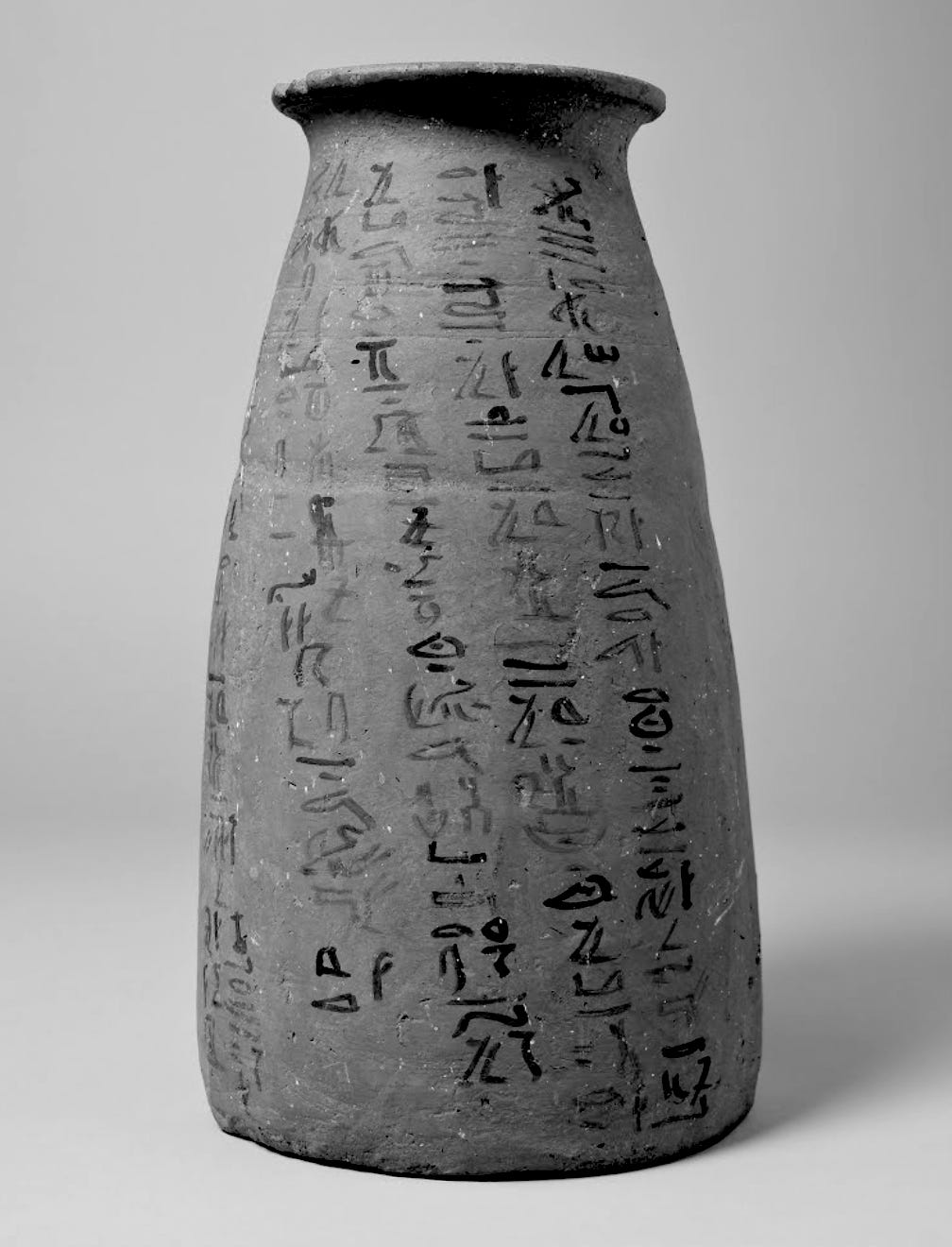
This first method is really quite simple, coming to us from Ancient Egypt and well-documented via objects from the archaeological record, such as this stunning jar (pictured below) dating back to 2199 - 1976 BCE, or approx. 4,000 years ago during the 11th Dynasty. The inscriptions here are a plea directed at the writers dead father and grandmother, asking for their help in protecting his family from enemies. Such letters to the dead were, by all accounts, a common means of asking for assistance when attempting to solve a variety of mortal problems. To increase the odds of successes, they could be given alongside offerings of food and libation, sometimes being buried with the deceased individual whose spirit they seek help from.
Incantations and Oils
Moving to Ancient Mesopotamia, their ghosts were a very real, persistent, and, at times, threatening presence: if they were unhappy in the afterlife, they may return to areas and people familiar to them and make their unhappiness known via a haunting, sometimes inflicting their victims with illness or worse, death. (See my previous post for more.) If this sounds familiar, that is because the ghost hasn’t really changed all that much, with this very same thousands-of-years-old narrative still being used to describe many contemporary hauntings at the hands of the unrestful and/or vengeful dead.
In Ancient Mesopotamia, the ghostly culprit could be communicated with through a variety of rituals with the help of a practitioner, most often a necromancer. One such ritual is graciously detailed in a cuneiform manual dating back to approximately the 7th century BCE, i.e. 2,600 - 2,700 years ago.
According to this manual, the necromancer would first prepare a special oil known as sahab (also nirhab) consisting of crushed mouldy wood, fresh leaves of Euphrates poplar, various liquids (including oil), animal hairs, and more, shall I say, unique ingredients. This mixture was then applied to the face while reciting these words:
ni-ir-ha-ab ni-ir-ha-ab gedim ni-ir-ha-ab
gedim igi-bar ni-ir-ha-ab
gi-ir-gi ia-am-ma-ke
igi-an igi-bar gedim am-ma-ke
This translates roughly to “(With) sahab-oil, sahab-oil, Oh ghost, sahab-oil, Oh ghost, be you visible (with) sabah-oil!”
And there you have it! A intriguing means of communicating with the dead through the use of a ghost-seeing oil, straight from an Ancient Mesopotamian necromancer. Well, them and the many cuneiform experts doing the heavy translating for us, like Dr. Irving Finkel who writes about ghostly Mesopotamian matters in his book “The First Ghosts”.
Fuji (Planchette Writing)
Now, let us talk about something which may feel increasingly more familiar to you: planchettes!
When we hear the word “planchette” we tend to picture the triangular object which accompanies a Ouija board. But such tools and similar techniques have a much longer history, including that of fuji (扶乩) meaning “supporting the planchette/spirit-writing”—a form of automatic writing used to communicate with deities within some Chinese religious practices as early as the Song dynasty (960 to 1279 CE, or 1066 to 747 years ago) and, perhaps more notably, during the 19th century.
When taking part in fuji, a group of practitioners would surround a sieve or tray filled with a granular substance, usually incense ash, sand, or both. Next, one to two spirit mediums would channel the deity while holding a Y-shaped wooden branch, often from a peach or willow tree because “ghosts are known to fear them.” (Formoso, 2014) If successful, the tool would mark divine characters into the grains which another practitioner would read allowed. Meanwhile, an accompanying scribe would document the messages and, later, copy them to be shared with others.
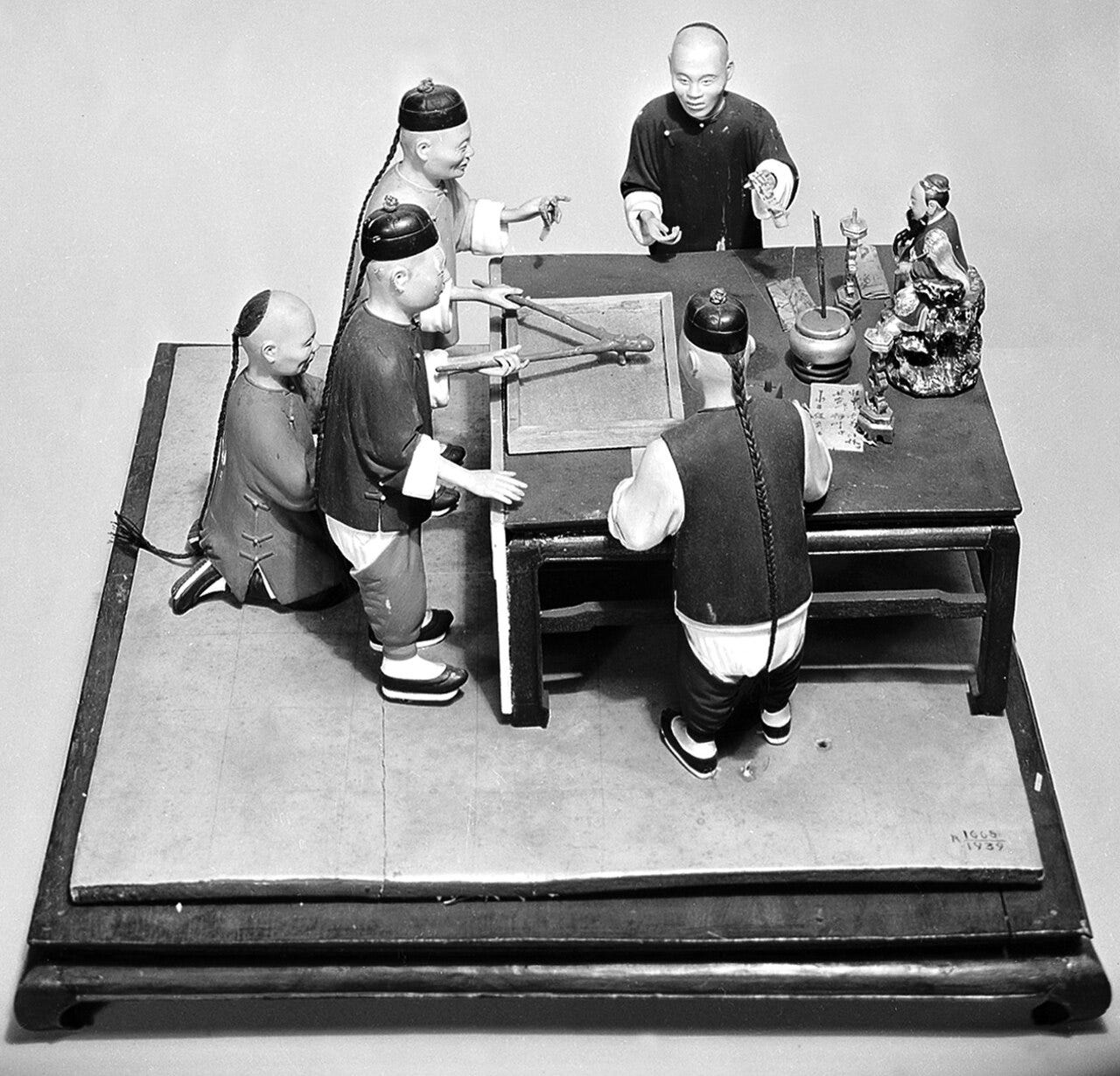
Note the “anti-ghost” element—this ensured that the information being relayed unto them via fuji was from a trusted divine source, and not some pesky ghost. In fact, this same Y-shaped tool also maintained a purpose outside of fuji, having been wielded by those wishing to chase off ghosts and cast them out of the sick. Remember earlier when I mentioned how upset ghosts could cause illness and death? We can see here just how universal this concept is.
Moreover, if you have seen depictions of a Victorian-era séance, the practice of fuji may ring bells of familiarity. This is due to the heavy borrowing that Western spiritualists, who formed the backbone of the Victorian séance craze, pulled from Eastern religions and their otherworldly communicative modus operandi, including that of fuji. (Seriously, we need to start giving credit where credit is due.)
Would you try any of these methods? Let me know in the comments below!
Sources/Works Cited:
Jar inscribed with letter to the dead, The University of Chicago Institute for the Study of Ancient Cultures, Collections
Dr. Irving Finkel, “The First Ghosts”, Hodder, 2021
Fuji (Planchette Writing), Wikipedia
Bernard Formoso, “Spirit-Writing and Mediumship in the Chinese New Religious Movement Dejiao in Southeastern Asia”, Anthropos: International Review of Anthropology and Linguistics, 2014